Why roadmap chaos starts with spreadsheets – and gets worse as teams grow


There is a moment in a lot of growing product teams when the roadmap stops feeling like a source of clarity and starts feeling like a small administrative crisis.
It usually begins innocently enough. A roadmap lives in a spreadsheet. Someone duplicates it for a leadership meeting. Another version gets copied into slides for a quarterly planning deck. A product manager updates one file but forgets another. Soon, different teams are working from different versions of the truth, and suddenly, the product roadmap that was supposed to align everyone is doing the opposite.
That kind of chaos rarely starts with bad strategy. More often, it starts with a tool that can no longer handle the job.
As Patrick Denison, Customer Success Manager at airfocus, explains, teams often end up with “so many versions of their roadmap that they stop knowing which is the real roadmap.” In his conversations with product leaders, that confusion compounds fast as the business grows.
“With spreadsheets, teams end up with so many versions of the roadmap that it becomes hard to know which one is the real roadmap,” he says. “In airfocus, the data is live, so you have one place for the roadmap rather than a stack of static copies.”
can support your team.
Book a demo
Spreadsheets work... until your roadmap has to do more than list features
To be fair, spreadsheets are not the enemy. For a small team, they can be fast, flexible, and familiar. When there are only a few priorities to track and only a handful of people need visibility, a spreadsheet can feel perfectly adequate.
The problem is that roadmaps do not stay simple for long.
As soon as they become something more than a basic feature list, the cracks start to show. Updates are manual. Timelines are static. Context lives somewhere else. Stakeholder versions multiply. And every time someone asks for a different view of the roadmap, the easiest option is often to make another copy.
This is where the mess begins. Instead of one shared planning environment, teams end up managing a collection of documents that are always at risk of falling out of sync. By the time a roadmap spreadsheet is circulated, reviewed, and brought into a meeting, parts of it may already be out of date.
Patrick says this is one of the most common pain points he hears from teams that are still relying on spreadsheets: Their roadmap files are “immediately out of date.” Which means the document people are using to make decisions is already losing accuracy the moment it is shared.
Growth turns a simple roadmap into a coordination problem
This only gets more painful as companies grow because scaling a product organization adds more moving parts.
There are now multiple teams contributing to the same strategy. Each team has its own initiatives, features, deadlines, and dependencies. Product leaders want a high-level view across the organization. Product managers need a more detailed view of what is in progress. Sales and customer-facing teams want to understand what is coming next. Executives want confidence that work is aligned with the company’s priorities.
At that point, your roadmap is more than just a planning document. It has become a coordination system, and coordination is where spreadsheets begin to break down.


A static sheet can list priorities, but it struggles to show how work connects across teams, how initiatives roll up into broader goals, or where dependencies and overlaps are emerging. Patrick describes this as a challenge that becomes especially acute for CPOs overseeing three, four, or five teams at once. What looked manageable when one team owned one roadmap becomes much harder when several teams are feeding into the same product direction.
The hidden cost of spreadsheet roadmaps is misalignment
The obvious downside of spreadsheets is admin overhead. The less obvious downside is misalignment.
When teams cannot easily see how their work relates to other teams, it becomes much easier for duplicate work to happen. Two teams may solve similar problems without realizing it. Dependencies stay hidden until they become blockers. Stakeholders lose confidence because every roadmap conversation begins with a debate over what is current.
Over time, that uncertainty changes the nature of product planning and, instead of discussing trade-offs, sequencing, and strategic choices, your teams spend their time clarifying status, chasing updates, and reconciling conflicting versions. The roadmap becomes reactive when it should be strategic.
This is why roadmap chaos tends to get worse as teams grow. The larger the organization, the more expensive it becomes to rely on disconnected planning artifacts that need constant manual maintenance.
What a roadmap needs to become as teams scale
As product organizations become more complex, the roadmap has to evolve with them.
It needs to be live rather than static. It needs to connect high-level initiatives to the underlying work and make room for customer feedback, prioritization, and delivery progress, rather than forcing each of those things into separate tools and documents. And it needs to support different views for different audiences without creating an entirely new version every time someone asks a different question.
This is where Patrick says airfocus changes the equation. Instead of treating the roadmap as a spreadsheet that has to be copied, updated, and redistributed, airfocus gives teams one live workspace connected to the underlying work.
“The data is all live,” he explains, “because it is connected to development platforms. airfocus lets teams link this all together, from initiatives to features to stories to feedback. That means teams have one place for the roadmap, rather than multiple versions floating around the business.
“And we’ve also got different views to see that data,” he adds. “You can show leadership one version, product another, and sales another, without having to create separate roadmap documents every time.”


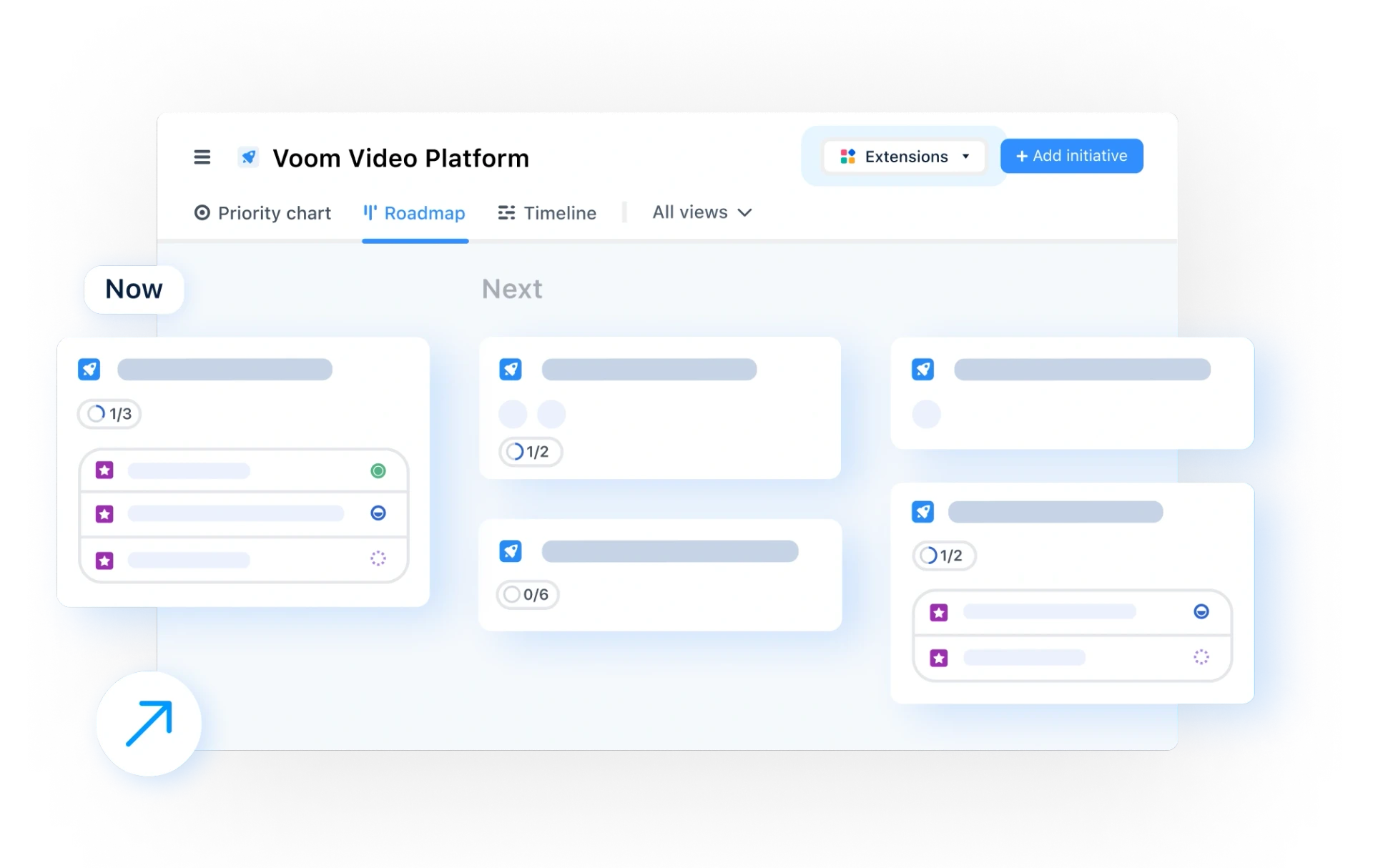
Patrick adds that airfocus is also dynamic in a way that spreadsheets simply are not. The same item can appear in a board view, a quarterly roadmap, and a timeline view, and when it changes in one place, it updates everywhere else.
That matters because product leaders, product managers, executives, sales teams, and customer-facing stakeholders rarely need the same level of detail. In airfocus, teams can share the right view with the right audience without creating yet another copy of the roadmap.
The other big difference is structure. Patrick explains that in airfocus, teams can separate work into connected workspaces for initiatives, features or epics, stories, and feedback – and then “link this all together.” So instead of managing strategy in one place, delivery in another, and feedback somewhere else, teams can see how work rolls up from detailed execution to higher-level priorities. That gives PMs room to manage the detail while still giving leaders the strategic view.
Why this matters most for product leaders
For product leaders, the value in airfocus is seeing whether your organization is actually aligned.
Patrick says this challenge becomes much more acute when a CPO is overseeing three, four, or five teams at once. At that point, the real question is no longer just what one team is building, but whether multiple product streams are supporting the same strategic initiatives, where dependencies exist, and whether teams are drifting into overlap or duplicate work.
That is where airfocus’ hierarchy and portfolio-style views become especially useful. Patrick explains that separate teams can manage their own epics and stories, but those items can still roll up into shared initiatives set by product leadership.
And when leaders need to look across teams at the same level of work, rather than just at the initiative level, that is where product portfolio management comes in. As Denison explains, a CPO may want hardware and software epics “in one workspace” because there may be dependencies between them.
“What product leaders need is a clear view of where they are, where they’re going, and how they’re going to get there,” Denison says. “When that’s all connected in one place, they can walk into stakeholder conversations with much more confidence.”
That is a much stronger answer to roadmap chaos than better version control alone. It means airfocus is not just replacing a spreadsheet with a cleaner spreadsheet. It is replacing static planning artifacts with a live system for alignment, visibility, and decision-making.




Emma-Lily Pendleton
how airfocus can support your team.
Book a demo
Read also


Build great roadmaps