How to turn scattered customer feedback into product decisions


Most product teams aren't short on customer feedback. But they are short on a system for making sense of it.
Requests come in through sales calls, support tickets, customer success conversations, email threads, Slack messages, CRM notes, and ad hoc docs. Product teams are hearing customers all the time. The problem is that the signal is fragmented. Leadership asks what customers want most, sales wants to know whether a request is gaining traction, and product is left trying to piece together the answer from half a dozen different places.
That is where feedback starts to lose value. When customer input is scattered across too many tools and teams, it becomes much harder to spot patterns and compare urgency, or even to simply connect what customers are saying to what ends up on the roadmap.
Sales may be logging feature requests in a CRM. Customer success may be tracking pain points in spreadsheets or notes. Support may be seeing recurring complaints in tickets. Product managers may keep their own interview notes, call recordings, and research docs elsewhere. Every team has part of the picture, but nobody has the whole thing.
This fragmentation makes feedback harder to interpret and harder to trust. Loud requests can seem more important than recurring ones simply because they are more visible, while other teams start to feel like requests are disappearing into a black hole.
can support your team.
Book a demo
Why scattered feedback leads to weaker product decisions
When feedback is scattered, the real risk goes beyond inefficiency. It weakens the quality of product decisions and the team’s ability to defend them.


Important patterns are easier to miss when similar requests are spread across different systems. Product teams end up relying more heavily on anecdotes because the evidence is hard to compare. Sales may push for a high-profile customer request without seeing whether other accounts share the same pain. Customer success may know a problem is growing, but struggle to prove how widespread it is. Leadership may ask what matters most to customers and get three different answers from three different teams.
That makes prioritization harder to trust. If a feature is prioritized, can the team show the demand pattern behind it? If a request is deprioritized, can they explain why? Without a clearer system, roadmap decisions start to look subjective, even when there is real customer signal behind them.
What better feedback management actually looks like
Better feedback management starts with creating more structure around the requests a business already has.
This usually means centralizing customer input from different teams, organizing it consistently, and giving product a way to identify patterns rather than treating every request as a one-off. It also means adding context. Which customers are affected? How painful is the issue? Is the request tied to churn risk, expansion opportunity, or a specific account segment? Does the same theme appear across multiple conversations?
The ultimate goal is to make the signal clearer. Once feedback is easier to compare and interpret, it becomes much more useful in discovery, prioritization, and roadmap conversations.
How airfocus helps teams turn feedback into decisions
This is where airfocus gives teams a more useful system. Patrick Denison, Customer Success Manager at airfocus, says one of the biggest problems he sees is feedback being spread across too many places: “It lives in Slack, it lives in email, it lives in HubSpot. When that happens, product teams spend more time gathering inputs than learning from them.”
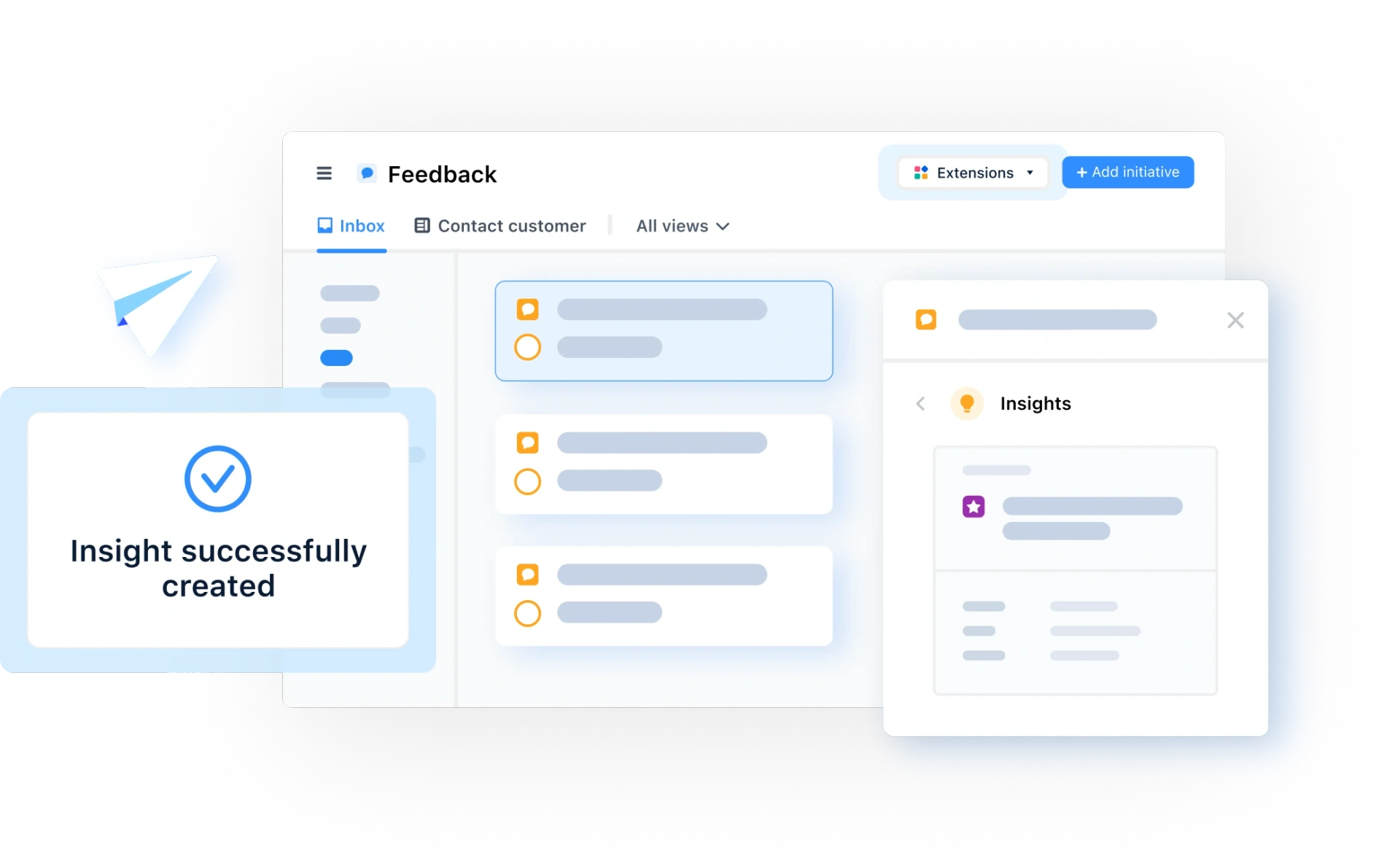
airfocus helps bring that feedback into one place and connect it to the rest of the product workflow. Instead of leaving requests scattered across different tools, teams can centralize their feedback, link it to feature ideas or roadmap items, and make it easier to see what is isolated and what is part of a broader pattern.

Patrick also points to the value of adding more structure to feedback itself. In airfocus, teams can categorize requests by criteria such as pain severity, customer tier, or deal size, then use that context to understand not just what customers are asking for, but also how urgent or commercially important the issue may be. As he explains, “You’ve got the customer feedback associated with each request, which makes it easier to justify why one item is moving up the roadmap and another is not.”
That matters even more when feedback volume grows. Patrick says that airfocus' AI-generated summaries and insights can help teams process large amounts of input more quickly, so PMs are not forced to read everything one item at a time before they can spot themes. The result is tidier feedback management and a clearer bridge between customer signal and product decisions.
Why this matters for more than just product
One of the biggest benefits of better feedback management is that it improves trust across teams.
When feedback is centralized and connected to product decisions, sales gets better visibility into what is being considered. Customer success has a clearer way to show where customer pain is building. Leadership gets a more reliable picture of emerging patterns. Product has a stronger foundation for explaining why certain items are being prioritized.
That helps close one of the most frustrating gaps in growing organizations: other teams hear customer needs but cannot always see how those needs influence the roadmap. A better system doesn't just make feedback easier to collect; it also makes it easier to analyze. It makes product decision-making easier to understand.
Feedback is only valuable if teams can act on it
Most product teams already have the customer signal they need. The challenge is turning that signal into something structured, visible, and actionable.
airfocus helps product teams centralize customer feedback and connect it directly to prioritization and roadmap decisions, so feedback stops being scattered noise and starts becoming evidence.



Emma-Lily Pendleton

Read also


All product feedback in one place