Customer insight software for product teams: How AI is turning feedback into roadmap decisions


AI made engineering faster. Coding now accounts for a shrinking share of the time between an idea and a shipped feature, and backlogs move quicker than they used to. This sounds helpful. Unless the team is building the wrong thing, in which case it just gets you to the wrong place faster. The bottleneck moved from shipping to deciding, and few decisions depend more on getting the input right than what to do with customer feedback.
Most product teams already have more of that feedback than they can use. The problem is that the feedback rarely arrives in a form that's actionable.
can support your team.
Book a demo
What is customer insight software for product teams?
Customer insight software helps product teams collect, organize, analyze, and act on customer feedback and signals. It pulls scattered input like support tickets, sales call notes, survey responses, product analytics, research docs, and Slack threads all into one place, then connects that input to the decisions it should inform: what to build next, what to deprioritize, and what to tell a stakeholder who is asking why.
The category exists because feedback management on its own stops at collection. Insight software goes further: It links a piece of feedback to a roadmap item, a customer segment, or a strategic bet, so the feedback has somewhere to go.


Why customer insight breaks down in growing product organizations
Ask five people on a product team where customer feedback lives, and you’ll get five different inboxes, two Slack searches, and a shrug. Patrick Denison, Customer Success Manager at airfocus, asks product managers a version of this question on most of his onboarding calls: Where does your feedback live right now?
The answer is rarely simple. As Patrick explains, when he asks, “They kind of laugh, because feedback is all over the place. It’s in Slack channels, it’s in email, it’s in HubSpot.”
That scatter is a structural problem, not a discipline one. As product organizations grow past a single team, feedback enters through more channels than any one person can monitor. For example, customer success hears it on calls, sales hears it in deal reviews, support hears it in tickets, and product hears a fraction of it secondhand, usually after the decision has already been made.
The result is feedback that exists everywhere and yet informs nothing. A customer success manager knows a deal-breaking request exists. A product manager building next quarter’s roadmap never sees it. Strategy gets set in a vacuum, then gets quietly relitigated the moment a churn risk and a roadmap collide.


The difference between customer data and product insight
Data tells a product team what happened, such as a support ticket count, a feature request tally, or a survey score. Insight tells a team what’s important, why it matters, and what decision it should inform. The difference determines whether feedback shapes a roadmap or accumulates without ever informing a decision.
What to look for in customer insight software
A few capabilities separate genuine insight software from a feedback inbox with a search bar:
Feedback capture from multiple sources: If a tool only captures what gets typed directly into it, most of the organization’s signal never arrives.
Tagging and clustering: Raw feedback needs structure before it means anything: by theme, by customer, by severity.
Connection to product ideas, opportunities, and roadmap items: Feedback that links to a roadmap item is evidence. Feedback that doesn’t is a list.
Prioritization workflows: Insight should feed directly into how a team scores and ranks what to build, not sit beside that process as a separate reference.
Customer and segment context: Ten requests from your ideal customer profile carry a different weight than ten requests from accounts you are trying to grow out of.
Visibility for stakeholders: Customer success, sales, and support all hold pieces of the picture. They need a way to see how their input affected a decision, not just a form to submit it.
AI-assisted synthesis with human judgment: AI can read volume no human has time for. The team still decides what the pattern means.
Integration with the broader product operating system: Insight that lives apart from prioritization, roadmaps, and delivery is insight a team has to manually carry from one tool to the next.

How airfocus connects customer insight to product decisions
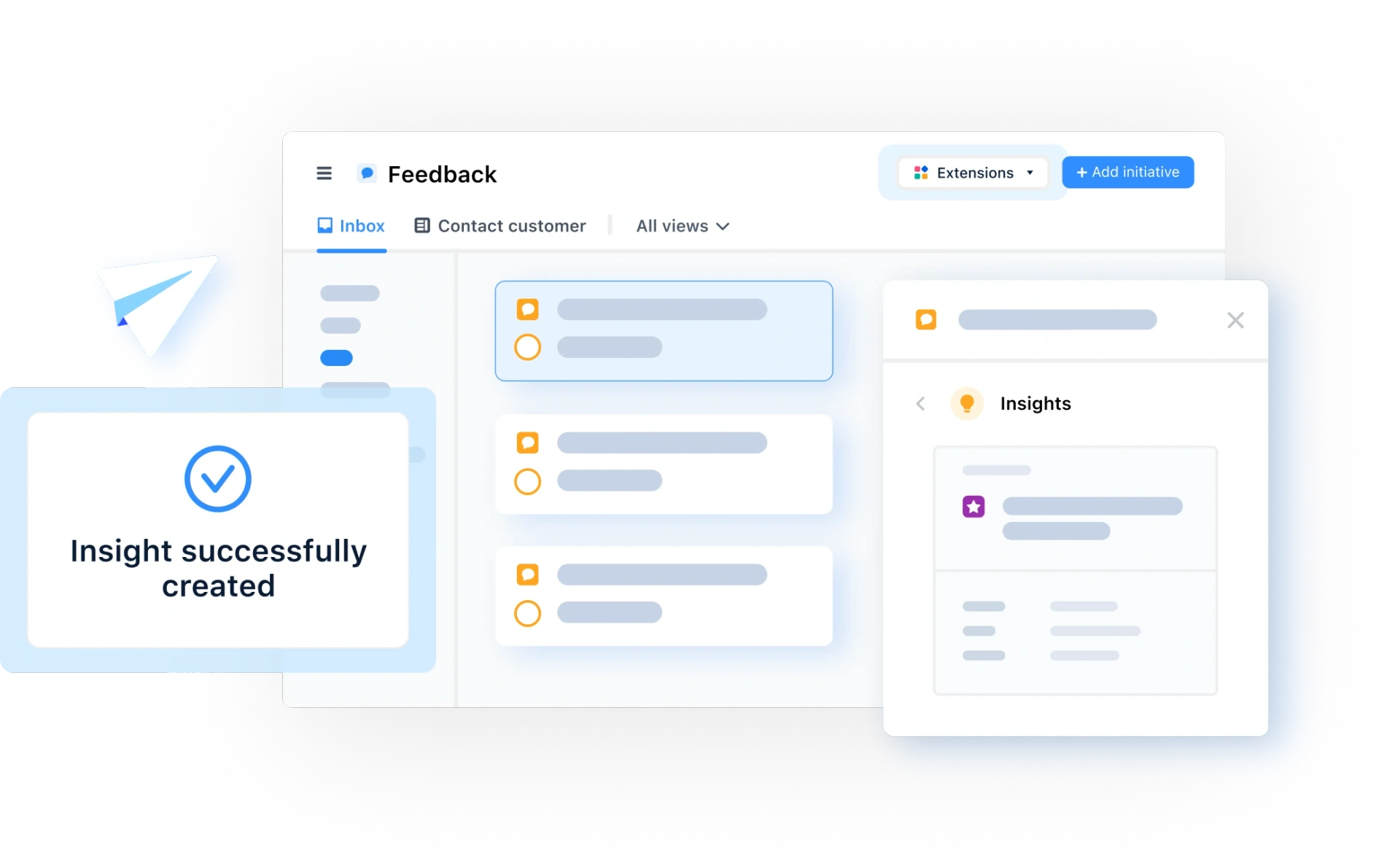
The Insight agent turns scattered feedback into a quantifiable metric by linking it directly to an epic or an opportunity.
Patrick describes the effect on a backlog item once feedback accumulates against it: “A portfolio app with 29 pieces of feedback linked to it has a real pulse. The ones with nothing against them don’t need much attention; we don’t have to spend mental energy looking at those.”
That same linked feedback becomes raw material for AI synthesis. Once enough feedback sits against an item, the Insight agent can read all of it and summarize the pattern, turning what would be hours of manual review into a result a product manager can act on in minutes. This is the Pillar 1 promise in practice: intelligence that acts, not information that displays.
Linked feedback also feeds airfocus’ prioritization workflows directly. Patrick describes what the priority rating app gives product teams that gut feeling alone never could: “data-driven metrics behind the question of why you’re doing something.” Reach, customer tier, and revenue impact roll into a score that sits next to the roadmap item itself, and the decision becomes traceable from customer signal to outcome rather than dependent on the meeting where it was made.

That same traceability changes the conversation when a decision gets challenged. As Patrick explains, “If anyone pushes back and asks why, the product manager can say eight customers requested it, and it scored highly on the data-driven metrics.” The reasoning survives the meeting it was made in.
The same connected system gives customer-facing teams a reason to stay engaged with product decisions rather than wait to hear about them. Patrick describes what changes for customer success once feedback and prioritization sit in one place: “We can tell the product team we’ve got a tier-one customer here and this is a deal-breaker. It makes the CS team feel included in the product process.” That is the coordination tax, automated away: Customer success spends its time surfacing signal instead of chasing visibility.
This is what the shift looks like in practice: The product team stops being the coordination function and becomes the decision function. The Insight agent triages and links feedback. Autofill keeps the data clean. The product manager still decides what an emerging pattern means and what to do about it. Agents and humans work hand in hand: The system does the triage, and the team makes the call.




Jeff Meyer
how airfocus can support your team.
Book a demo
Read also


All product feedback in one place